Showing posts with label Trump. Show all posts

Monday, August 7, 2017

Iran: Moving Forward With the Correct Western Policy


NCRI - The Iranian regime has enjoyed appeasement from the West for years despite its outright belligerence across the region. Former President Obama was so keen to keep the Iran nuclear deal in place that he turned a blind eye to many nefarious acts that the regime was responsible for. He also ignored blatant issues that should have been addressed, or at least acknowledged, like the poor human rights record in the country.
When President Trump took office, he made it clear that he would not be passive like his predecessor. He has identified Iran as a major problem in the Middle East and has vowed to tackle the issue.

Iran’s bellicosity in the region has been going on for decades. During the eighties, it was behind an attack on the US Embassy and barracks in Beirut. During the nineties it was behind the attack on the Khobar Towers in Saudi Arabia. And these are just a few incidents.
When Obama pulled all US troops out of Iraq, he basically handed the country over to Iran. He pulled them out too soon and gave Iran the opportunity to further its export of the revolution with the help of several extremist proxy groups.
Because of the inaction of the US, and the rest of the West, Iran has been able to have free reign over the entire Middle East and has terrorised Syria, Yemen, Iraq, Saudi Arabia, Bahrain and Afghanistan.
It has been reported recently that Iran has been supplying weapons to the Yemeni Houthis. It has also been providing the group with drugs which it sells to create revenue to keep the soldiers on the ground. The Islamic Revolutionary Guards Corps (IRGC) is present in Syria where it helps the Houthis smuggle weapons.

They are now using waters in the Gulf near Kuwait to get past an arms shipment embargo. It allows Iranian ships to move equipment to smaller vessels in areas where there are less inspections. This will often be in the waters around Kuwait.
Iran has been provoking US vessels in the area and many believe that these are attempts to see how President Trump will react. Last month, an Iranian vessel approached a US Navy ship which eventually had to fire warning shots.
The Trump administration is showing that it is committed to curbing the Iranian threat. He is taking steps that aim to limit Iran’s actions. This is contrary to that of Federica Mogherini, the EU foreign policy chief who is travelling to Iran for the inauguration of President Hassan Rouhani. Trump is at least showing Iran that its actions will have consequences. Mogherini is content to continue with the blind eye policy.
A new initiative has just been signed into law by Trump that will impose tight restrictions on Iran and its IRGC is being treated as a Specially Designated Global Terrorist group. Foreign companies will have to seriously consider the consequences of carrying out business transactions with Tehran.
Furthermore, many are calling for trade relations with Iran to be halted until it stops violating the human rights of its own people. They also call for Iranian forces to be removed from Iraq and Syria and for the ballistic missile program to be stopped.

Saturday, August 5, 2017

Trump sanctions set stage for necessary regime change in Iran

With the president’s signature on H.R. 3364, formally known as the Countering America's Adversaries Through Sanctions Act of 2017, the Trump administration — eager for legislative accomplishments in the wake of the GOP failure to repeal the Affordable Care Act — can take credit for turning the page on failed Obama-era policy toward the Islamic Republic of Iran. 
The bipartisan passage of the long-anticipated sanctions bill by both houses of Congress allows the administration to take aim at rogue regimes in Iran, Russia and North Korea. Disagreements over U.S. policy toward Russia notwithstanding, the White House can be confident that legislators overwhelmingly support confronting threats emanating from Iran and North Korea and are prepared for even stronger measures to curtail the influence of these dangerous regimes.
The White House should now build on the successful passage of sanctions legislation to push for regime change in Tehran as an appropriate next step.
ADVERTISEMENT
Trump administration surrogates can remind the American people that the White House first put Tehran on notice for engaging in regional destabilization shortly after Trump took office, pursued comprehensive sanctions targeting Iranian ballistic missile programs and directed the State Department to designate the Iranian Revolutionary Guard Corps (IRGC) as a foreign terrorist organization, thereby blacklisting it from the global economy.

The latest sanctions legislation effectively accomplishes this latter goal by extending all terror-related sanctions to the entirety of the IRGC as a Specially Designated Global Terrorist group. The question now is how far the Trump administration is willing to go to address the Iranian threat.
This question arose in June when the sanctions bill encountered delays, and it arose again in July when the White House, for a second time, certified Iranian compliance with the 2015 Joint Comprehensive Plan of Action (JCPOA). The move surprised many seasoned Iran experts familiar with Tehran’s belligerence, particularly given the president’s campaign pledges to scrap the porous agreement altogether.
In fairness to the White House, the day after certifying Iranian compliance with the Obama nuclear deal, the administration announced that it planned a thorough review of U.S. Iran policy. Some critics of the nuclear agreement believed that simply tearing it up on day one was not the best way to proceed.
But virtually all analysts agree that steps must now be taken to address the significant shortcomings of the JCPOA. The agreement’s weaknesses and omissions — the result of Obama-era eagerness to secure a deal at any cost — are well known on both sides of the aisle.
Trump’s embrace of the sanctions legislation may be an indication that he intends to adopt a more strategic policy toward Iran that would force concessions from the Islamic Republic or even encourage the transition to a new, democratic system of government. 
Secretary of State Rex Tillerson previewed this possibility in June and some Iran analysts have suggested that the Trump administration’s assertive posture toward Tehran points in this direction. But Trump, Tillerson and others must now pay attention to how they plan to facilitate regime change via “elements inside Iran” to ensure a permanent solution to the nuclear issue and other matters.
The July 1 gathering in Paris of tens of thousands of Iranian expatriates committed to democratic change, supported by senior members of the president’s own party, was sufficient to remove any doubts about the likelihood of regime change being successful. It was clear to all in attendance that there is a democratic alternative to the ayatollahs and regime change is within reach.
At the Free Iran rally, Maryam Rajavi, president of the National Council of Resistance of Iran (NCRI), characterized the then-pending blacklisting of the IRGC as necessary to facilitate a domestic uprising against a weakened Iranian regime. Recent protests suggest that ordinary Iranians have tired of the regime’s civil and political repression, human rights abuses and adversarial relationship with global powers, leaving them vulnerable to a "Persian Spring."
But Rajavi emphasized that it will take more than a single package of sanctions to ensure success for the resistance movement. Now that obstacles to the IRGC’s terrorist designation have been overcome, it is time to discuss how the U.S. and its allies can further undermine Iran’s hardline paramilitary and curtail its foreign influence. 
With provocative ballistic missile tests and harassment of American naval vessels in the Persian Gulf becoming a near routine occurrence, the Trump administration hardly needs a reminder of the importance of confronting the IRGC. Now the White House must decide whether it is prepared to bring an end to the regime that created the hardline paramilitary organization. 
By taking assertive actions and supporting the Iranian opposition, Trump can signal not only his displeasure with JCPOA but also write the next chapter in U.S. policy toward Iran by building on the successful passage of congressional sanctions legislation.
Tehran’s rogue status and lack of legitimacy presents the White House with a unique opportunity to further isolate the Iranian regime and deny it the resources to suppress its own people the next time they rise up and demand change. The question is whether the administration is willing to seize the opportunity and push for regime change in Tehran.
Ivan Sascha Sheehan, Ph.D., is director of the graduate programs in Global Affairs & Human Security and Negotiations & Conflict Management in the School of Public and International Affairs at the University of Baltimore. Follow him on Twitter @ProfSheehan.

Friday, August 4, 2017

TRUMP ADMINISTRATION DISPUTING OVER FUTURE OF IRAN NUCLEAR DEAL


By INU Staff
INU  Following the 2015 nuclear deal agreed between Iran and major world powers, the US administration has to grant or deny Iran’s compliance every 90 days. During the Obama administration, Iran was granted compliance every time. This was not surprising. Not because Iran has followed the deal to the letter, but because former President Obama turned a blind eye to all of Iran’s belligerent actions. He was too afraid that the nuclear deal would fall through, so he appeased the Iranian regime to no end.
President Trump has made no secret of his disproval of the nuclear deal. He talked about it during the election campaign, describing it as the worst deal. However, the deal is still intact but that does not mean he accepts it. He is willing to speak out against his advisors and may break with some of them in October when the deal is reviewed in October.
He promised to scrap the deal during the election process. However, if he does so, it will be a potential blow to relations between the US and major allies such as France, Germany and Great Britain – backers of the nuclear deal.
/Iran has carried out many violations of the nuclear deal and has provoked many countries as well as carrying out ballistic missile activities. Whether France, Germany and Great Britain would back Trump is unknown.
The 2015 deal has resulted in an opening for business between Europe and Iran, and sanctions on the country were eased with Iran’s promises to curb its nuclear activities.
The US Secretary of State Rex Tillerson and President Trump strongly disagree on the action that needs to be taken. Last month, Trump told reporters that he thinks Iran will be judged noncompliant at the next review in October. Tillerson said earlier this week that this would have serious and significant consequences.
Tillerson believes that if the Iran deal remains intact, the United States will have more leverage over Iran than if there was no deal in place. He said that if the deal remains intact, the US can “make the point to Iran that we expect you to get back in line with the spirit of the agreement and we’re going to stay here and hold you accountable to it”.
Although Trump and his Secretary of State are not on the same page regarding the future of the nuclear deal, it is a positive change to the previous administration’s complete neglect to confront Iran’s belligerence.

Wednesday, August 2, 2017

Trump signs Russia-Iran sanctions bill into law

U.S. President Donald Trump meets with Russian President Vladimir Putin


Washington, August 2, 2017 - U.S. President Donald Trump has signed into law new sanctions against Russia, Iran and N. Korea that were passed overwhelmingly by Congress last week.
A White House official said on Wednesday he had signed the bill, and White House adviser Kellyanne Conway confirmed this during an interview with Fox News.
Given the delay since Congress approved the legislation last Thursday, there had been speculation that the Republican president might be resisting signing a bill that has already provoked countermeasures by Russian President Vladimir Putin.
Trump accepted the new sanctions, which also include Iran and North Korea. The bill had enough support in Congress to override a presidential veto.
The new sanctions measure, the first major foreign policy legislation approved by Congress since Trump took office in January, includes a provision allowing Congress to stop any effort by the president to ease existing sanctions on Russia.
It also cracks down on Iran and North Korea for activities including their missile development programs and human rights abuses, including seeking to punish foreign banks that do business with North Korea.
Source: Extracted from a Reuters report

Wednesday, July 26, 2017

How Trump should handle Iran

US President Donald Trump


Forget the nuclear deal. Trump's real priority should be regaining leverage over Tehran.
By ERIC EDELMAN and CHARLES WALD

POLITICO, 25 July 2017 - Last week, the Trump administration recertified that Iran is complying the nuclear agreement, setting off predictable debate between who those want to exit the deal immediately and those who see it as his predecessor’s signature foreign policy achievement.
But for all the will-he-or-won’t-he attention on Trump’s decision, the focus on the nuclear deal is missing the point: The administration’s real agenda on Iran doesn’t hinge on the nuclear agreement—a dangerous deal that puts the U.S. in a impossible situation. Instead, the Trump administration’s priority should be restoring leverage against Tehran, so that we can dissuade Iran from sprinting toward a bomb and create far more favorable circumstances to negotiate an agreement that—unlike Obama’s deal—actually prevents a nuclear Iran.
Abiding by the Joint Comprehensive Plan of Action (JCPOA), as the agreement is known, will only enable a nuclear and hegemonic Iran. It provides Tehran significant financial, military and geopolitical benefits, both upfront and over time, in exchange for minimal, reversible and temporary concessions on its nuclear program. As the JCPOA’s restrictions fall away in coming years, Iran will be legally permitted to produce everything it needs for a nuclear weapon.
Yet, the JCPOA also forfeits what little leverage the United States had – in the form of economic sanctions – with no way to rapidly rebuild pressure. Thus, leaving the deal would free Iran to sprint for a nuclear weapons capability in a year or less, likely far less time than the United States would need to rebuild the international sanctions regime. Our partners to the deal would be unlikely to go along with us, further undermining our leverage.
This catch-22 stems from earlier failures to develop compelling pressure on Iran, as reported by JINSA’s Gemunder Center Iran Task Force, which we co-chair. The Obama Administration created a false narrative that eschewed military options against Iran’s nuclear program and regional aggression, leaving Congress to focus narrowly on sanctions. These sanctions may have brought Tehran to the table, and helped keep it there long enough hammer out a deal, but alone they could not force it into an acceptable agreement.
Consequently, the JCPOA puts Iran on track to become as intractable a challenge as North Korea is today, and very possibly worse. Threatening the United States and its allies, including with nuclear weapons, is a core ambition of both these rogue regimes. Yet while Pyongyang’s relentless pursuit of this goal has only isolated and impoverished it, the JCPOA does the opposite for Tehran.
The Trump administration must not abide this untenable and deteriorating situation. The United States now needs what it clearly lacked before: a comprehensive strategy of robust leverage against all of Iran’s destabilizing behaviors.
The first step is full enforcement of the JCPOA – including potentially re-imposing suspended sanctions in response to Iranian cheating – as a clear signal that Tehran can no longer flout its nuclear obligations. However, given the damage already done by the deal and the fact time is not on its side, the administration’s ongoing strategic review and threats of renewed sanctions are insufficient.
American policymakers must also rebuild military leverage over Iran. Contingency plans to neutralize Iran’s nuclear facilities, if it materially breaches or withdraws from the deal, should be updated to reflect its growing nuclear infrastructure and military capabilities under the JCPOA. Just like it already appears to be doing against North Korea, the Pentagon must also develop credible capabilities in preparation for a possible shoot-down of future Iranian ballistic missile tests. U.S. Navy ships must also “fully and responsibly” utilize rules of engagement to defend themselves and the Persian Gulf against rising Iranian harassment.
It is equally important the United States work with its allies. The recent ten-year Memorandum of Understanding on defense assistance to Israel should be treated as the floor for cooperation, in particular on missile defenses shielding U.S. forces, Israel and its neighbors from increasingly capable arsenals of Iran and its proxies.
Stronger regional collective defense is also needed. Saudi Arabia and the United Arab Emirates are shouldering the burdens of countering Iran’s growing footprint around the Arabian Peninsula. Formal U.S. military backing, and possible support from Israel, will raise the costs to Tehran of further aggression while reassuring our worried allies.
Public announcements and military exercises will make these intentions, capabilities and allied unity abundantly clear to Tehran. Strategic communications can also amplify investors’ continued wariness of the Iranian market and, in combination with human rights, terrorism and missile sanctions, increase internal strains on the regime.
These concentric pressures – none of which violate the JCPOA – will help deter Iran from pursuing nuclear weapons capability whether it complies, violates or withdraws from the deal.
They also create the most favorable conditions for a renegotiated agreement – one enshrining many of the parameters initially demanded by the Obama Administration. This should include: “anytime, anywhere” inspections to verify the absence of weaponization activities and secret facilities; dismantling Iran’s nuclear-capable missiles; ensuring Iran could never enrich enough fissile material for a nuclear weapon; and no sunset or end to sanctions or embargoes until inspectors verify the completely peaceful nature of Iran’s nuclear program.
Neither staying in nor exiting the JCPOA can accomplish America’s overriding priority in the Middle East. Only increased U.S. leverage can prevent a nuclear Iran.


Ambassador Eric Edelman is former Undersecretary of Defense for Policy.
General (ret.) Charles Wald is former Deputy Commander of U.S. European Command. They co-chair JINSA’s Gemunder Center Iran Task Force.

Friday, July 7, 2017

Surprise: Trump and France’s Macron may wind up allies after all

 Trumps surprise Paris visit marks shrewd political calculation World · Frances Macron ...


AFP ,  July 4, 2017 -- The catalyst for a blossoming friendship between President Trump and his French counterpart Emmanuel Macron could well be a mutual desire to rein in Iran.
There are signs of an early thaw: Macron just eagerly joined Trump by vowing French jets will bomb Syria alongside American ones if Bashar al-Assad’s forces use chemical weapons again.
Plus, Macron invited Trump to attend the Bastille Day festivities on France’s national holiday July 14. And Trump accepted.
Not everyone is cheering, though. Syria is Iran’s client, and Trump is building a regional coalition against Tehran while Congress tries to push through new sanctions. Iranian Foreign Minister Javad Zarif was in Paris over the weekend to try to preempt Macron from joining the pile-on.
Europeans and former Obama officials fear the toughening of Iran policies as well. Last week, former State Department official Jeff Feltman, now heading the United Nations’ political department, gave the Security Council a glowing review of Iran’s compliance with the nuclear deal. That was echoed by top European Union diplomats.

America’s UN Ambassador Nikki Haley


America’s UN Ambassador Nikki Haley spoiled the party by listing Iranian violations of Security Council resolutions, from missile launches and manufacturing to arms sales and the spreading war and terrorism across the Mideast. “We won’t turn a blind eye to the Iranian regime’s behavior and will work with the global community to enforce sanctions,” Haley said.
So which way will France swing? “On this, we’re somewhere in the middle between the EU and America,” a French diplomat told me over coffee here.
It’s a fair assessment. While Zarif tried his charm on Macron, the People’s Mujahedin of Iran (MeK), an anti-regime group, held its annual rally in a Parisian suburb. The group’s leader Maryam Rajavi’s top applause line was a promise that regime change in Iran is “within reach.”
Well, maybe. But here’s the point: France hosted Rajavi and her disciples, conferring sort of legitimacy on the anti-mullah group for decades — even as the State Department listed the MeK as a terrorist group. Former French Foreign Minister Bernard Kouchner addressed the group Saturday. As did some of Trump’s closest allies — Newt Gingrich, Rudy Giuliani, John Bolton — who came as close as possible to saying Trump, too, supports regime change, without quite declaring it in so many words.
You don’t have to support the MeK, or regime change for that matter, to notice the tug of war going on here: Once European leaders are done trying to change Trump’s mind on climate and immigration, they’ll try to influence his Iran policy, begging him not to be too harsh with the mullahs.
It isn’t all so cut-and-dried, though. When questioned about French companies’ push to do more business in Iran, officials point out that in some cases they’re being beaten to deals by major American firms — Boeing, for one, is strong-arming their Airbus out of the Iranian market.
Trump and Macron ought to hash that out this weekend at the G20 and in Paris on July 14. The end of the Obama era has left both countries wondering what their roles are. After all, France took a tougher line on Iran during the runup to the nuclear deal than Team Obama did. Macron — and Trump, for that matter — should follow the example set by Macron’s predecessor.
Perhaps a renewed effort to punish and isolate Iran to better address the nuclear threat will even, eventually, spell the end of a regime that for decades has oppressed Iranians and wreaked havoc on the Mideast and beyond.
If so, this could be the beginning of a beautiful friendship. And more peaceful handshakes.

Tuesday, June 27, 2017

France’s Macron invites Trump to Bastille Day festivities

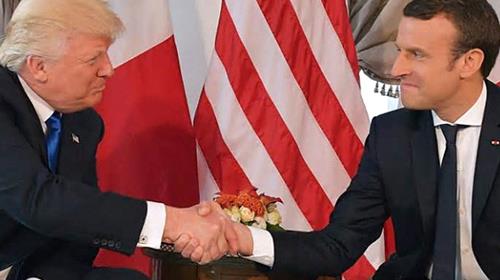
French President Emmanuel Macronn and US President Donald Trump


French President Emmanuel Macron invited his US counterpart Donald Trump on Tuesday to attend the country's traditional Bastille Day military parade, despite public differences over the Paris Agreement on climate change.

FRANCE 24 with AFP, 27 June 2017 - Macron invited Trump and First Lady Melania Trump to attend the parade that is held in the French capital every year on July 14. The French president’s office said the US leader promised to examine the invitation.
This year, the event will mark 'the 100th anniversary of the US joining the war with French troops in World War I,' an official in Macron's office said.
On July 14 last year, a radicalised Tunisian man killed 86 people as he rammed a truck through a crowd watching Bastille Day fireworks in the French Riviera city of Nice.
A Trump trip to Paris would follow a visit to France by Vladimir Putin in May when Macron hosted the Russian leader at Versailles palace.
The 39-year-old Macron made his mark on the international stage when he gave Trump a white-knuckle handshake at a NATO summit on May 25.
He later mocked Trump's decision to pull the United States out of the 2015 Paris Agreement to combat climate change.
Macron's English-language appeal to 'make our planet great again' -- a riff on Trump's own slogan of making America great again -- became a social media hit.

Chemical ‘threat’


Macron and Trump also agreed on Tuesday on the need for a 'joint response' in the event of another chemical attack in Syria.
They decided on the matter during a telephone call, a day after Washington said Syrian President Bashar al-Assad may be preparing another chemical weapons attack.


The US warned that Assad’s government would pay a 'heavy price' if it went ahead with such an assault.
A Pentagon spokesman said US intelligence had noticed suspect activity at the launch site of the regime's apparent chemical strike in April.


Days after that strike on a rebel-held town, the US launched a cruise missile strike on the airfield in retaliation -- the first direct US attack on the Syrian regime.
The French foreign ministry refused to say Tuesday whether it, too, had information about possible preparations by the Syrian regime for a chemical attack.